
For years, I thought my problem was a lack of discipline.
I downloaded productivity apps, created detailed schedules, watched motivational videos, and even asked AI to build perfect daily plans for me.
The plans were great.
The problem was that I didn't follow them.
When you're feeling depressed, overwhelmed, exhausted, or stuck, the issue usually isn't a lack of knowledge. You already know what you should do.
The real challenge is taking the first step.
After years of experimenting with different systems, I discovered three simple methods that helped me rebuild my momentum and slowly regain control of my life.
None of them are complicated.
None require expensive software.
And all of them work in the physical world, where action actually happens.

Method 1: The Red X System, Make Achievement Visible.
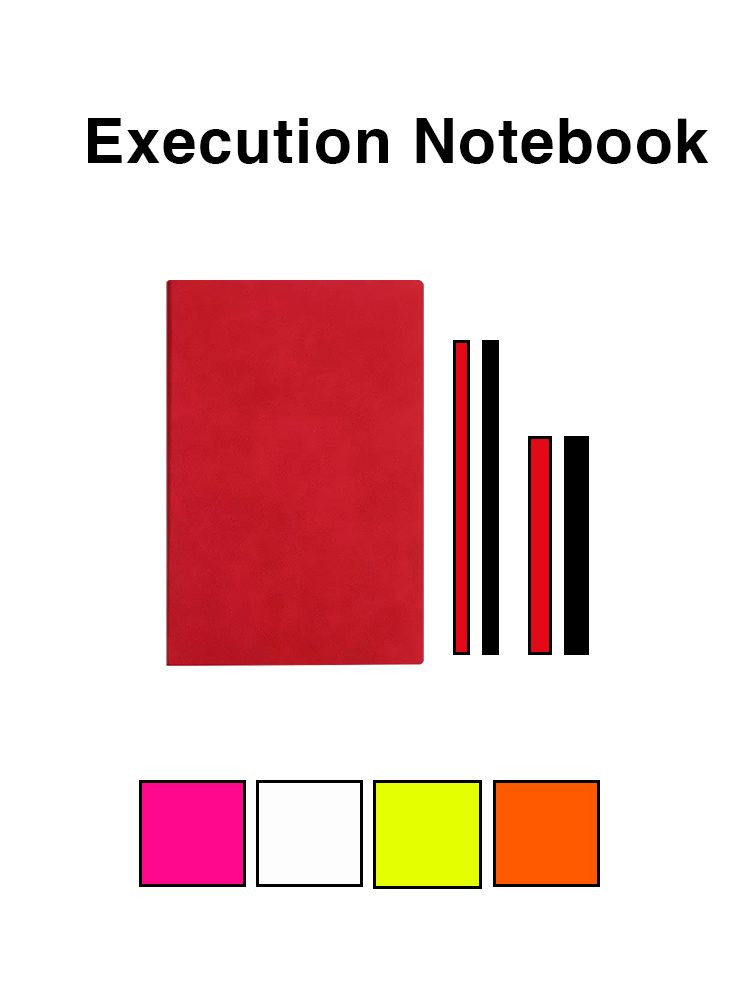
Tool: A Red Notebook and a Red Pen
This is the simplest habit I've ever used.
Every time you take an action, draw a red X.
-
Got out of bed? Draw an X.
-
Opened your laptop? Draw an X.
-
Sent an email? Draw an X.
-
Put on your running shoes? Draw an X.
-
Read one page? Draw an X.

The action doesn't need to be impressive.
It only needs to exist.
Most people wait until they complete something important before giving themselves credit. That's a mistake.
Progress is built from tiny actions.
By the end of the day, your notebook becomes a visual record of movement.
You stop judging yourself based on feelings.
You start judging yourself based on evidence.
And evidence is usually much kinder than your inner critic.

The Four-Zone Productivity System, Make Your Time, Projects, and Ideas Visible at a Glance.
The notebook is divided into four sections.
1. Time Tracking Column
This is the most important foundation.
Simply shade blocks of time throughout the day and write what you worked on during those periods.
At a glance, you'll see:
-
Where your time went
-
How long projects actually took
-
How your energy was spent
Time is your most valuable asset. By visualizing it, you gain control over it.
2. Ideas Column
Creative thoughts appear unexpectedly.
This section captures ideas, inspirations, concepts, and future possibilities that may not be useful today but could become valuable later.
3. Miscellaneous Notes Column
This section is for small reminders and non-essential information:
-
Call someone back
-
Buy a gift
-
Clean the house
-
Remember a new vocabulary word
Useful, but not urgent.
Method 2: Turn Invisible Work Into Visible Work
Tool: A Time-Tracking Notebook
Most modern work happens inside our heads.
Designers think.
Writers think.
Managers think.
Developers think.
At the end of the day, we feel exhausted but often can't explain what we actually accomplished.
This creates frustration and self-doubt.
The solution is simple:
Track your time visually.
Instead of writing endless to-do lists, create a timeline for your day.
Shade blocks of time and label what you worked on.
After a week, you'll begin seeing patterns:
-
Which projects consume the most time.
-
Where distractions occur.
-
How much work you're actually doing.
When work becomes visible, progress becomes measurable.
And measurable progress creates motivation.

Method 3: Break Every Big Project Into Sticky Notes
Tool: Sticky Notes on a Wall
One of the biggest causes of procrastination is uncertainty.
We know where we want to go.
We just don't know what the next step is.
Whenever I start a large project, I first write the project name on a large note.
Then I break it into smaller parts.
Then I break those parts into even smaller tasks.
Each task gets its own sticky note.
When a task is completed, I draw a red X on it.
The wall slowly transforms into a map of progress.
This method was inspired by UI and UX design.
When people download a new app, they're guided through each step until they understand exactly what to do.
Projects should work the same way.
You should always know:
-
Where you are.
-
What you've completed.
-
What comes next.
Confusion creates procrastination.
Clarity creates action.
Why Physical Tools Work Better Than Apps
This may sound strange in an age of AI and productivity software.
But physical tools have one major advantage:
They're visible.
When you close an app, the reminder disappears.
When you lock your phone, the task disappears.
When you shut down your computer, the project disappears.
But a notebook sitting on your desk doesn't disappear.
A wall full of sticky notes doesn't disappear.
They continue reminding you of your goals without requiring notifications, alarms, or willpower.
The Real Goal Isn't Productivity
Most productivity systems focus on doing more.
I think that's the wrong goal.
The goal is movement.
One action.
Then another.
Then another.
When you're struggling with procrastination, anxiety, depression, or burnout, you don't need a perfect plan.
You need proof that you can move forward.
That's what these tools provide.
Not motivation.
Not magic.
Just visible evidence that you're capable of taking the next step.
And sometimes, that's all you need to change everything.


Laisser un commentaire
Ce site est protégé par hCaptcha, et la Politique de confidentialité et les Conditions de service de hCaptcha s’appliquent.