
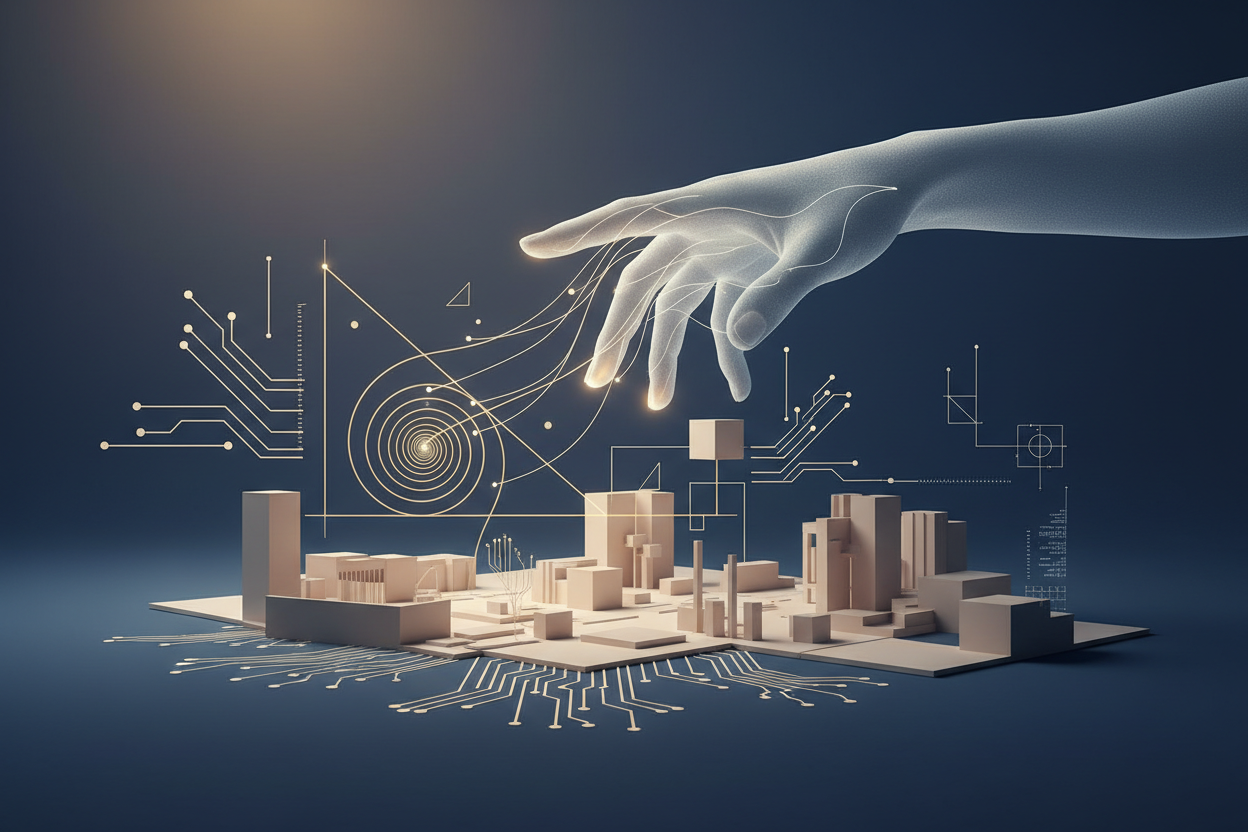
Everyone I know in design is having the same argument right now.
Half the conversation is panic: AI will replace us, creativity is being automated, the profession is collapsing. The other half is dismissiveness: AI is just a tool, nothing has changed, the fundamentals still apply.
Both sides are wrong. Here's what I actually observed after spending seven days and nearly a hundred attempts building something with AI — knowing nothing about code before I started.
What AI Is Genuinely Good At
Exploration at speed. I generated 20 visual directions in the time it used to take me to finish one. Early-phase moodboards, concept variations, "what if we tried this" iterations — AI handles these faster than any human can.
Lowering the barrier to entry. I installed a complex open-source AI system on a cloud server nearly a hundred times over seven days without any prior coding knowledge. Each failure taught me something. Each error message, when I pushed AI to explain it, eventually became navigable. The full story of that experiment is here.
These are real capabilities. Not trivial ones.
Where AI Consistently Fails
The most frustrating moment wasn't an error message. It was when AI confidently told me to click a button that didn't exist. When I pushed back — "Look, it's not there" — it said "Oh, the interface was updated." It wasn't lying. Its training data has a cutoff. The platform moved; the AI didn't know.
This reveals the fundamental limitation: AI operates on patterns from the past. Design operates in the present, responding to context that hasn't been trained on yet. The gap between those two things is where human judgment lives.
Visual inconsistency is the clearest example. AI-generated imagery has a particular quality — not bad exactly, but slightly off in ways that accumulate. Brand trust is built on consistency. Consumers feel inconsistency before they can name it. A product line where the images don't quite match, where the voice shifts subtly between pieces — this signals a company that isn't in control of its own identity.
Design, at its core, is trust. And trust requires a human being who is accountable for every decision.
Where Human Design Meets AI Identity
The Photoshop Parallel
When Adobe launched Photoshop, illustrators panicked. The pattern is familiar now — but the outcome wasn't what the illustrators feared.
Before Photoshop: technical execution consumed enormous time. Revisions were expensive. The tool was the bottleneck.
After Photoshop: value shifted to art direction, concept, cultural sensitivity, strategy. The thinking became the bottleneck. Great designers multiplied their output. Mediocre designers could no longer hide behind technical difficulty.
AI is doing the same thing. The question isn't "will AI replace designers?" The question is: what kind of designer are you when the technical execution is no longer what differentiates you?
What This Means for How I Build Fairies Whisper
I use AI extensively in my work. For exploration, for generating options I wouldn't have thought of, for speeding up early-phase decisions.
But every piece that ships from Fairies Whisper has been physically tested — on my face, on my wrist, against my neck. The earring sizing guide I wrote came from me personally wearing every size in front of a mirror, not from generating descriptions. The AI Agent custom engraving collection came from a human insight — that people form real relationships with their AI companions and those relationships deserve physical form — not from an algorithm predicting what would sell.
The ghost in the machine is not AI. The ghost in the machine is the human designer who decided what the machine should make, and why, and for whom.
That ghost doesn't automate.
Ren — founder of Fairies Whisper. Using AI to explore, using human judgment to decide.



Leave a comment
This site is protected by hCaptcha and the hCaptcha Privacy Policy and Terms of Service apply.