
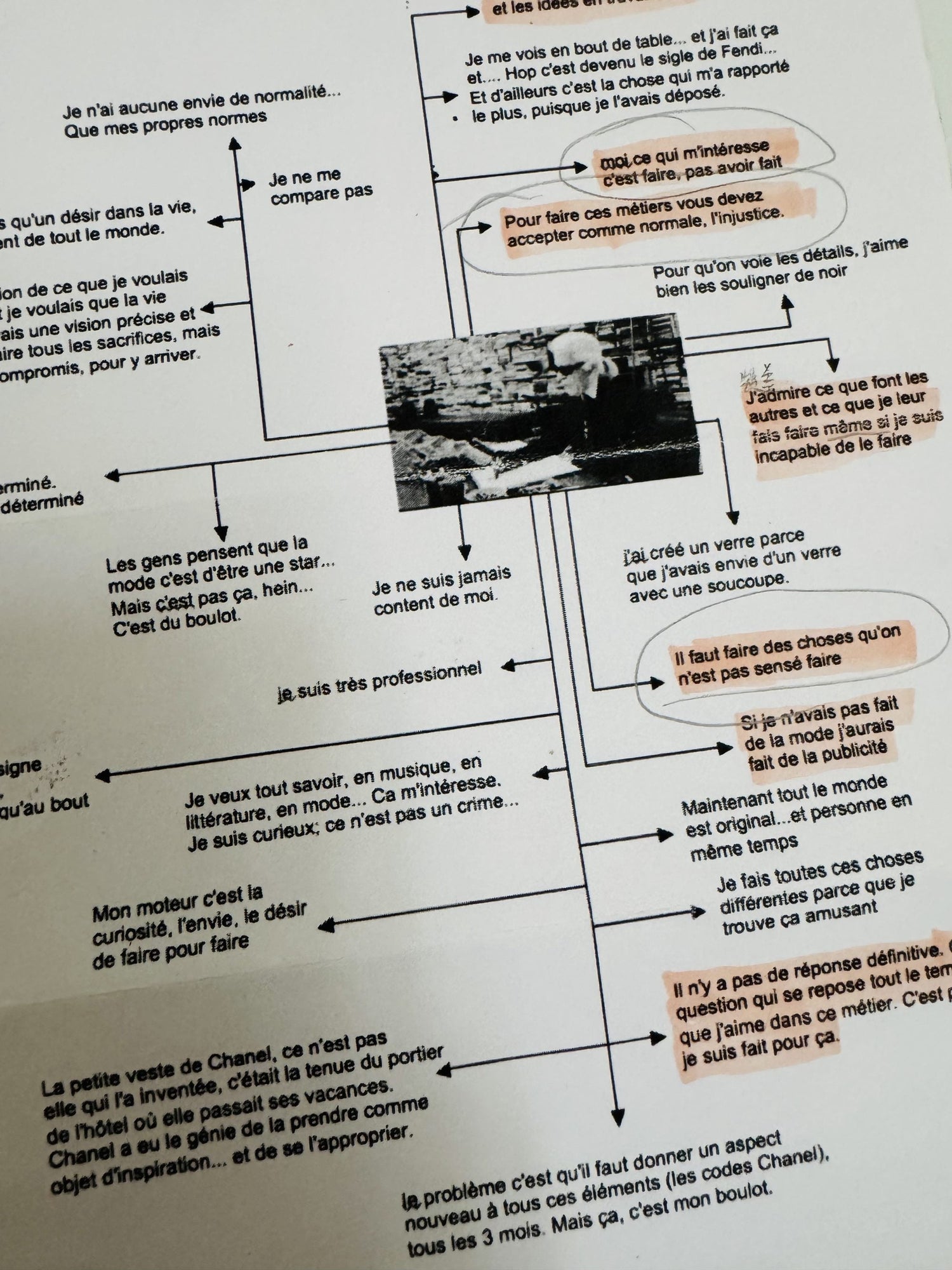
In design, you must choose a professional idol. Back in school, our teachers would ask us to select a highly respected, contemporary professional in our field to study and model our careers after. I’ve noticed that professionals in other fields do the exact same thing—they look up to the absolute authority in the niche they want to conquer.
My choice was Karl Lagerfeld. Actually, he wasn't my first choice; I initially picked Aubrey Beardsley, the classic illustrator. But my teacher told me he was too old, too far in the past. We were studying commercial fashion design, yet my scope of knowledge was limited to ancient art books. Meanwhile, other students were actively learning by following contemporary artists on Instagram, attending academic conferences, or studying active brands. At the time, Chanel collaborated with our school, so our teachers heavily recommended studying Karl.
They showed us his documentaries, detailing his work habits and daily life. That was when I truly understood the qualities a professional designer must possess—what they need to do every single day, what they must persist in, and how they should approach life and work. I also realized that being a designer, especially a great one, is profoundly lonely. It requires reading an enormous amount of books, whether novels, philosophy, or essays. I was never a big fan of reading novels, and as a result, I found it incredibly difficult to tell concise, vivid stories. Smart people can brilliantly summarize an entire concept in a single, effortless sentence, while I always felt a bit clumsy with words.
But having an idol like Karl means having a guiding light who can wake you up with a distilled truth. I constantly think of his words while I work. He famously believed that just as appetite comes with eating, inspiration comes with working. Whenever I start a project and stare at a blank screen with absolutely no starting point, I remember this. It is incredibly practical because it is entirely true.
Every single time, the ideas only start flowing after I begin working. Step by step, the path reveals itself. Since we are in the creative industry, pulling something out of thin air is an agonizing process. Trying to finish it all at once is paralyzing. But I've found that if you just start chipping away at it bit by bit, the pain diminishes. You continuously optimize your ideas, and eventually, you feel a profound sense of control over your work, leading to a sustained sense of accomplishment.
Choosing a mentor like this gives you a push to simply take action. When we encounter difficulties, it helps to realize a universal truth: everyone faces these exact same hurdles. If you are struggling, the person next to you is struggling too. But if you just hold on—if you persist the way these greats did—you will eventually surpass many others and earn yourself breakthroughs.
A friend recently told me he had started studying design and found it agonizing, especially the dread of opening the software to make revisions. I told him that it is agonizing for me, too. This resistance is entirely universal. But I’ve learned that the faster I dive in, the easier it is to solve the problem. The absolute worst thing you can do is let the difficulty fester and build up in your mind.
Karl also mentioned that he often woke up in the morning with his best ideas and solutions. Recently, I started maintaining a regular routine, and I found that timely rest is magic. Putting down frustrating work to go exercise, play, or just sleep changes everything. When you come back, the insurmountable problem is suddenly not so hard anymore, and you can solve it much faster.
I know exercise promotes blood circulation. When I sit for too long, my brain fogs up and my head aches. I used to think lying down to rest would fix it, but it didn't; the headache would remain. My mother told me I needed to go run. At times, I felt so exhausted I could barely stand, let alone run, but having no better options, I forced myself out the door.
The results were miraculous. Without taking a nap or resting, just running two laps completely cleared my brain fog. I felt incredibly refreshed, energized, and all the fatigue simply vanished. I don't know the exact scientific mechanism behind this—I am completely ignorant about things outside my profession—but I know it works like magic. If your knowledge base is as narrow as mine was, let me tell you: this is a highly effective method.



Leave a comment
This site is protected by hCaptcha and the hCaptcha Privacy Policy and Terms of Service apply.