
When I first moved to Paris in my early 20s to study visual design, I was obsessed with being "noble."
I didn't want to copy anyone. I wanted to be 100% original. I believed that was the only way to prove I was truly talented — to earn a reputation as a "devil designer," the kind of creator people feared and respected.
I wasted years on this belief.
What I Actually Learned in Paris
The hard lesson: being totally original is often a nightmare — and not for the reasons you'd expect.
If a design has no references, no existing framework, no visual language the viewer can hook onto — it usually ends up weird, confusing, or just plain bad. Not because the designer lacks talent, but because design communicates. And communication requires shared context.
Real creativity builds on the past. The most powerful designs carry fragments of past brilliance, then remix them into something new. The Chanel jacket references military tailoring. The Hermès Birkin references working saddle bags. The designs that last aren't the ones invented from nothing — they're the ones that take something already trusted and push it somewhere it's never been.
I didn't understand this at 22. I understood it at 30, after years of watching which designs actually moved people — and which just impressed other designers.
The Two Traps Every Design Student Falls Into
The first trap: repeating the same tired concepts. Copying without depth, without understanding why the original worked. This is what most people call "derivative" work — and it deserves the criticism.
The second trap — the one nobody warned me about — is the opposite: trying to invent from scratch and ending up disconnected, incoherent, design that only makes sense inside your own head.
I fell into trap two hard. I even sarcastically copied classmates' ideas just to protest how derivative I thought they were. But ironically, their work succeeded — not because it was copied, but because it evolved from something already proven to work. They were standing on shoulders. I was trying to levitate.
How This Changed How I Design Jewelry
When I started Fairies Whisper, I finally understood what good referencing actually looks like.
The Feast series — gold-toned jewelry mixed with fast-food visual language — doesn't pretend to come from nowhere. It references both traditional luxury gold jewelry and Pop Art's strategy of elevating low-culture imagery. The combination creates something new. But you need both references for the tension to work. I write about how this series came together here.
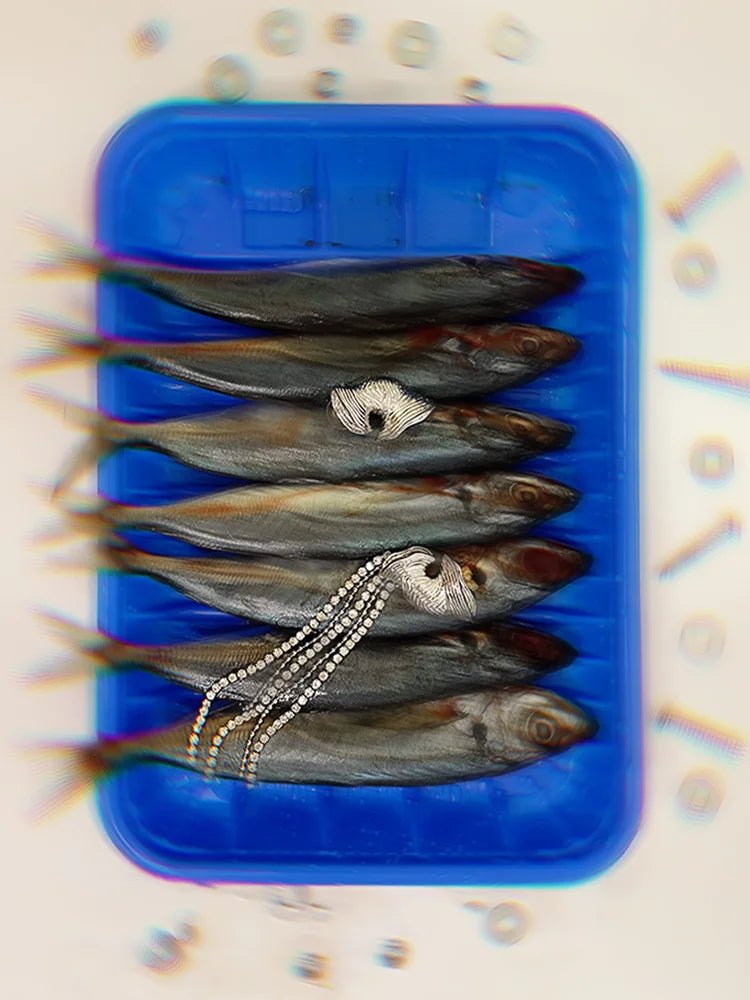
The Fish Market series started in a grocery store — looking at the iridescent textures of seafood skins and thinking about silver. That's not "original" in the sense of invented from nothing. It's observational. It's drawing a connection between two visual worlds that don't usually meet. That's what design actually is.
Pieces Designed With Intention, Not From Nowhere

What Good Originality Actually Looks Like
After a decade of making things, here's what I believe:
Originality isn't about having no references. It's about having so many references, absorbed so deeply, that the output becomes genuinely yours — not because it copies nothing, but because the combination is specific enough to be unmistakable.
Every piece I make at Fairies Whisper is tested on my own face and body before it ships. I write honestly about what works and what doesn't. That's not original in the sense of unprecedented — plenty of founders test their own products. But the specificity of my face, my neck, my conclusions — that's mine. Nobody else can replicate that.
Originality lives in the specifics. Not in the absence of influence.
The Practical Advice I Wish Someone Had Given Me
Study the things you love until you understand why they work — not just that they work. Then give yourself permission to use what you've learned.
The designers who shaped me most weren't the ones who taught me to be different. They were the ones who taught me to be specific. Different is easy. Specific is hard. Specific is also what lasts.
Ren — founder of Fairies Whisper. Studied in Paris, learned in China, still figuring it out.
The Designer's Essentials
Curated pieces that embody the balance between original design and wearable art.


Leave a comment
This site is protected by hCaptcha and the hCaptcha Privacy Policy and Terms of Service apply.